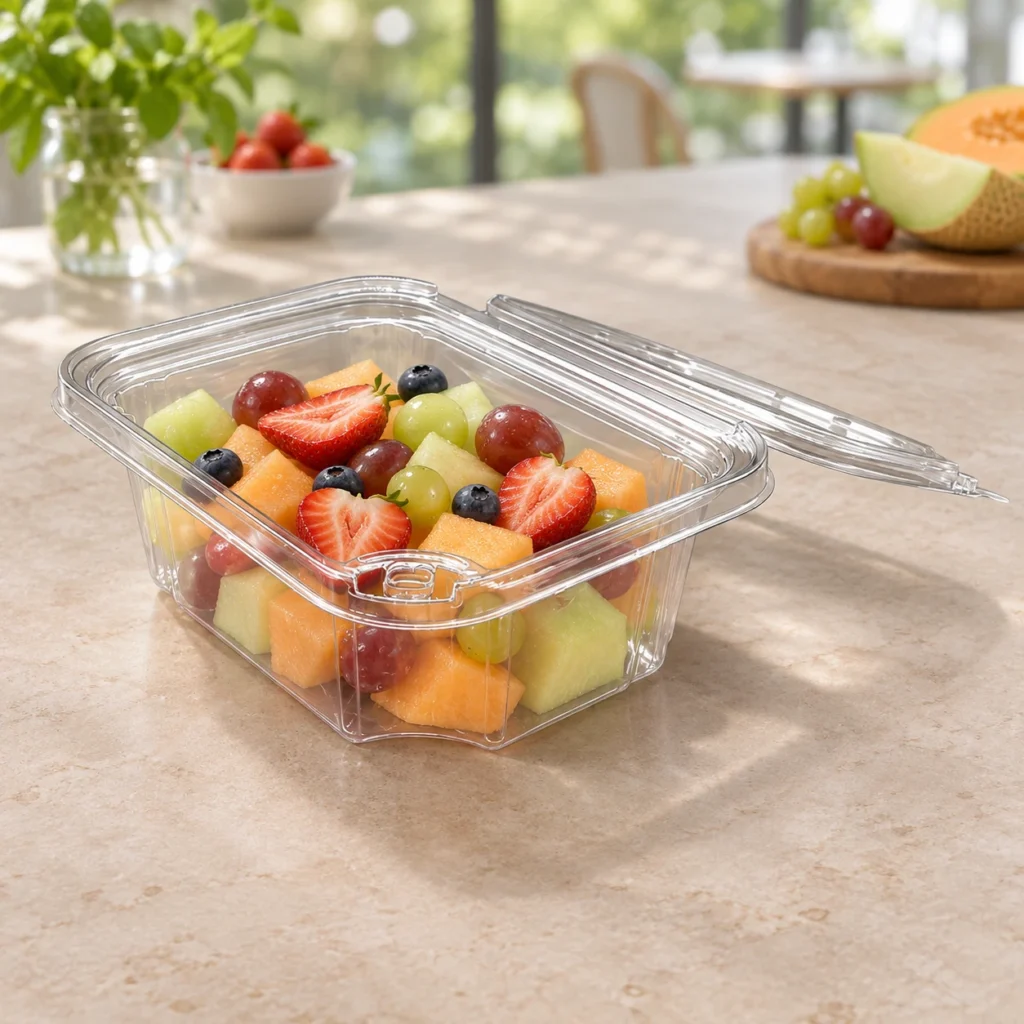
Choose plastic food packaging by matching the container to your food, packing process and delivery conditions, then confirm the proposed specification with a real sample. Start with the application rather than a photograph or material name. A tray that presents one product well may need a different depth, closure or packing arrangement for another.
For buyers comparing plastic food trays, clear containers, hinged clamshells and cake boxes, the most useful question is: What must this package do from filling to final presentation? This checklist explains what to discuss with a food packaging supplier before requesting a quotation or approving production. Examples come from Feiqi’s current product range; final dimensions, material suitability, minimum order quantities and lead times must be confirmed for each quotation.
1. Define the food and the packing process first
Prepare a short application brief before choosing a container. Describe the food as it will actually be packed, including its portion size, shape and any toppings or decoration. Include reference photographs with a ruler or a dimensioned drawing when possible.
Then record the conditions the package will encounter:
- Filling: how the food enters the pack and its temperature at that stage.
- Storage: the intended temperature range and expected storage time.
- Handling: whether packs are carried individually, stacked, displayed or placed in delivery bags.
- Presentation: what customers need to see and whether separate portions should remain apart.
- Destination: the market where the finished, packed product will be sold.
These details give the supplier a basis for discussing the exact finished container, rather than assuming that every product made from the same material performs alike.
2. Compare packaging formats against the job
Use the Feiqi food packaging collection as a starting point for a specification discussion. The following examples identify formats to review, not automatic recommendations for every food or use condition.
| Your packaging task | Format to discuss | Feiqi example | What to confirm |
|---|---|---|---|
| Arrange a prepared meal or individual food portion | Food tray | M2 White PP Food Tray | Usable internal space, depth and the intended covering or closure arrangement |
| Present food in a clear rectangular container | Clear container | F-24 oz PET Tamper-Evident Container | Actual portion fit, internal dimensions and closure details |
| Review a hinged packaging format | Hinged clamshell | C61 OPS Hinged Clamshell | Food clearance, hinge operation and closure during handling |
| Present a cake or separated portions | Round cake box | Round PET Cake Blister Box or FQ255 Tall PET Cake Box | Base layout, usable height and clearance around the actual product |
A product name or nominal size cannot replace a dimensioned specification. Confirm the measurements that matter to your food and packing equipment.
3. Confirm material suitability for the exact use
Feiqi’s collection identifies PP, PET and OPS in specific product names. Treat those labels as the beginning of the conversation. Do not infer a finished container’s temperature limits, reheating suitability, freezer performance or other performance claims from its material abbreviation alone.
Give the supplier your intended use conditions and ask for the specification and supporting information applicable to the proposed item. If a particular claim matters to your purchase, ask how it is supported for that product. Record the agreed conditions in the specification so that the sample review and production discussion use the same requirements.
4. Evaluate a sample with your actual product
A sample review should answer practical questions that a catalogue image cannot. Test the proposed container using your normal food portion and the handling steps you expect in operation.
- Check fit: measure the usable interior and confirm clearance for the food, toppings and decoration.
- Check filling: confirm that staff can place the product in the container without unnecessary handling.
- Check closure: review how the proposed pack opens, closes and stays closed during your intended handling.
- Check presentation: assess the packed product under your normal display conditions.
- Check transport: review the pack inside the bags, cartons or other outer packaging you plan to use.
- Record the outcome: note the sample reference, agreed specification, observations and any changes required.
State any untested conditions explicitly. An acceptable result in one packing scenario should not be treated as evidence for a different temperature, food or transport method.
5. Decide between an existing format and custom packaging
Begin by checking whether an existing format meets the brief. If it does not, identify the specific gap: dimensions, compartment layout, appearance or another requirement. This makes a custom packaging discussion more focused than simply requesting “a different box.”
Feiqi’s custom packaging process covers application review, format selection, sample confirmation and production planning, with mold development available for discussion. For a proposed custom design, request confirmation of tooling requirements, sample arrangements, order quantity, packing, lead time and shipping arrangements before proceeding. These details belong in the quotation; they should not be assumed from a standard product listing.
6. Send a clear quotation brief and review relevant documents
A useful enquiry brings the technical and commercial details together. Send your supplier:
- Food type, reference photos, portion dimensions and expected fill weight or volume.
- Your preferred existing product reference, or a drawing for a proposed custom format.
- Filling, storage and handling conditions, plus any performance requirements.
- Destination market, expected quantity and requested delivery timing.
- Outer packing requirements and the product documentation you need to review.
Feiqi’s Manufacturing & Quality page includes factory photographs and original supporting documents. Read each document for its legal entity, identified sample, dates and exact scope. A report for a named sample does not automatically establish the suitability of every container in a collection. Ask which information applies to the product you are considering.
Once your brief is ready, send Feiqi your packaging requirements to discuss a suitable format and request a quotation.
7. Frequently asked questions
What should I confirm before ordering plastic food trays?
Confirm usable internal dimensions, depth, the covering or closure arrangement, intended use conditions, packing and quantity. Review a sample with the actual food portion before agreeing production details.
Can Feiqi discuss custom food packaging?
Yes. Feiqi’s published process includes reviewing an existing format or a custom design and discussing mold development. Share your application, dimensions, photographs, destination market and expected quantity so the team can review the requirements.
Are minimum order quantities and lead times the same for every product?
Do not assume a single figure applies across the range. Feiqi confirms minimum order quantities and lead times with each quotation. Ask for the details for your chosen product, quantity and packing requirements.