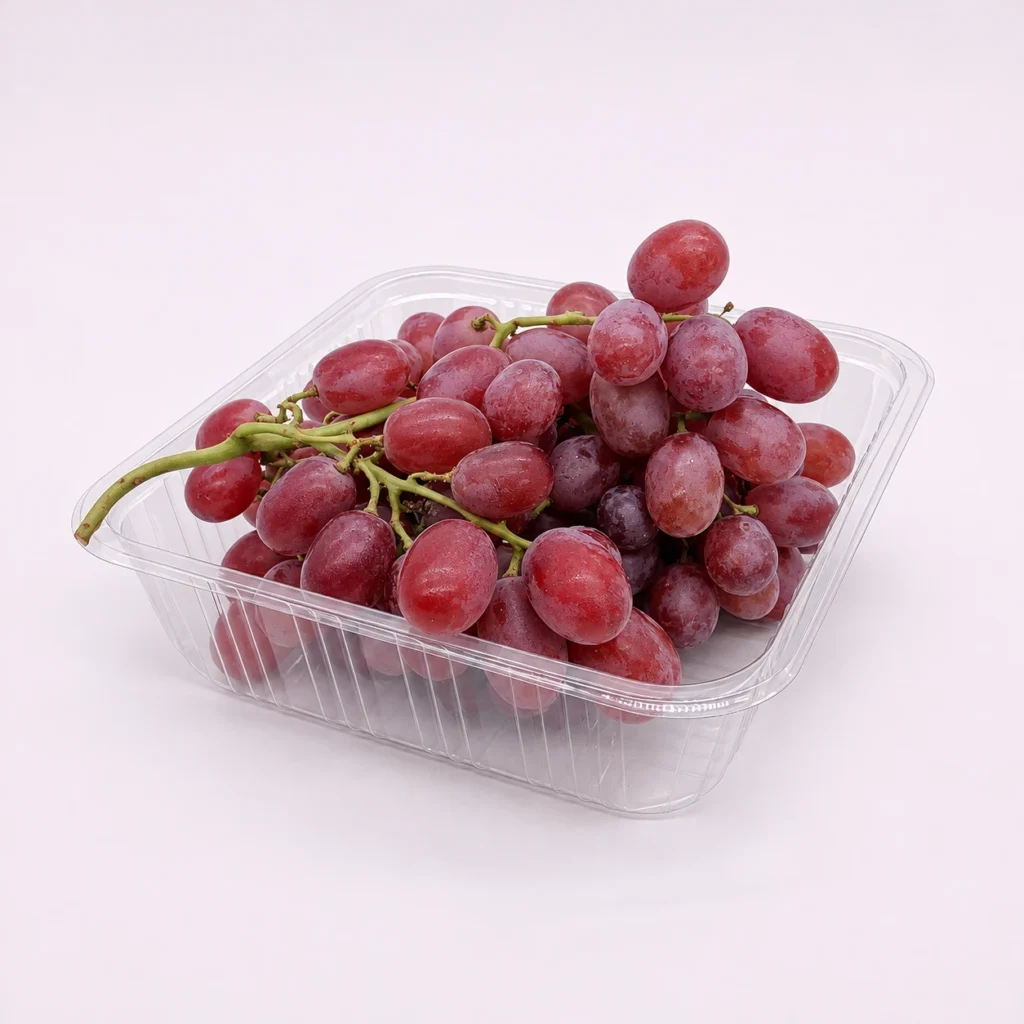
Choose clear fruit packaging by matching the fruit’s form, the usable space inside the pack, and the route from filling to display. Whole grapes, small apples, and fresh-cut melon present different challenges. Start with the actual fruit and a filled sample; use the product photograph and listed dimensions to build a shortlist.
Start with whole fruit or fresh-cut fruit
A useful packaging brief describes more than “fruit.” Specify the variety, typical fruit or piece size, portion weight, ripeness at packing, and whether the product is whole or cut. Include stems and irregular shapes when checking fit. A grape bunch can occupy much more space than its weight suggests.
Fresh-cut fruit needs particular attention to movement and released juice. UC Davis explains that cutting damages cells and that compression and vibration during handling can contribute to juice leakage. A pack that looks full on the filling table may behave differently after delivery.
| Fruit brief | Packaging question | Filled-sample check |
|---|---|---|
| Whole grapes or similarly irregular fruit | Can the bunch sit naturally without forcing the closure? | Check stems, top clearance, loose fruit, and contact with the lid. |
| Whole small apples or plums | Does the arrangement suit the fruit size range? | Try the largest and smallest fruit in the purchasing specification. |
| Fresh-cut melon or mixed fruit | Does the portion remain presentable after handling? | Observe piece movement, juice accumulation, closure condition, and label readability. |
Turn catalogue dimensions into a realistic fit test
Listed dimensions help compare formats, but they do not establish usable internal space. Tapered walls, ribs, corners, closure features, and lid shape can reduce room for fruit. Ask for internal measurements or a drawing, then trial the intended portion in a physical sample.
Three FEIQI formats provide different starting points for that comparison:
- FQ-1000B PET Fruit Clamshell — listed size 195 × 175 × 90 mm; a clear hinged format to assess for your whole-fruit arrangement.
- 1616 Clear PET Fruit Tray — listed size 165 × 165 × 50 mm; an open tray shown with grapes. Confirm any separate covering arrangement required by your operation.
- F-24 oz PET Tamper-Evident Container — listed size 190 × 145 × 60 mm; a format to sample with a fresh-cut fruit portion and your handling process.
These are listed product sizes, not confirmed internal dimensions or guaranteed portion capacities. Model names alone do not establish how many grams of fruit a pack will hold. Product suitability, closure operation, and required food-contact documentation should be confirmed for the proposed application.
Discuss ventilation and condensation together
Do not add holes simply because the product is fruit. Explain your cooling method, filling conditions, storage, transport, and retail display to the packaging supplier and your produce specialist. Ask whether the proposed sample has openings, where they are located, and whether labels or the outer carton will obstruct them.
University of California postharvest guidance describes a trade-off: packaging that limits moisture loss can also restrict cooling, so the system needs to suit its specific application. Venting is one design option, rather than a universal answer. Clear PET by itself does not establish a pack’s ventilation or anti-fog performance.
During trials, record when droplets or misting appear and whether the fruit remains visible. Compare conditions at filling, dispatch, receipt, and display. Review temperature changes and handling with the produce team before changing the pack. Packaging does not replace appropriate temperature control or the operation’s established food-handling procedures.
Run samples through the intended delivery route
Fill samples with representative fruit, including the normal size variation. Use the intended label, outer carton, packing pattern, and stacking arrangement. Follow the actual handling steps where practical, then inspect both the upper and lower packs.
Photograph each sample before and after the trial. Note fruit movement, pressure marks, juice collection, lid contact, opening effort, and visibility through the pack. Record the fill quantity and trial conditions so that a second sample can be compared fairly. Treat the results as evidence for that application, not as a general shelf-life claim.
Fruit packaging enquiry checklist
- Fruit variety; whole, peeled, or cut; and typical size range.
- Target portion weight and the intended arrangement inside the pack.
- Internal clearance needed for fruit, stems, and the closure.
- Cooling method, delivery route, display conditions, and required openings.
- Label position, carton layout, stacking, and sample acceptance criteria.
Send FEIQI your fruit packaging brief with photographs of the intended portion. Request samples and confirm the specification before placing a production order.
Frequently asked questions
Can one container work for whole and fresh-cut fruit?
It may be a candidate for both, but test each application separately. Portion fit, movement, released juice, closure requirements, and handling conditions can differ.
Does a listed 190 × 145 × 60 mm size tell me the internal space?
No. Obtain the usable internal dimensions and check the filled sample. Overall measurements do not account for every wall, corner, or closure feature.
Will ventilation holes prevent condensation?
Holes alone cannot guarantee that result. Review the fruit, moisture, temperature changes, airflow, labels, and carton arrangement together, then compare samples under representative conditions.
How can I confirm the right portion capacity?
Weigh the actual fruit into samples and close them normally. Check several portions across the expected size range; a model number or water-volume estimate does not confirm fruit capacity.