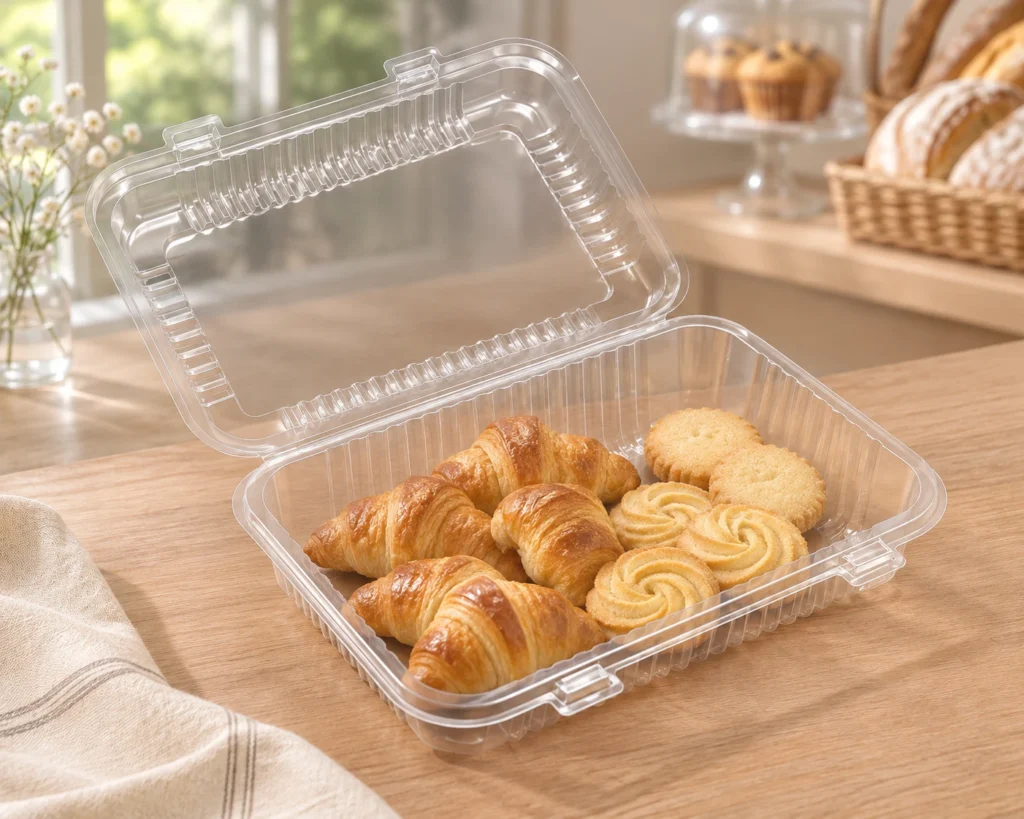
A useful food packaging request for quotation (RFQ) gives every supplier the same product brief, quantities and approval requirements. This makes quotations easier to compare and helps reveal missing information before you commit to a container or a custom mold.
You do not need a finished technical drawing to start. A clearly labeled photograph, a few measurements and an honest list of unanswered questions can be more useful than a long email asking for the “best price.” Use this checklist to turn your packaging idea into a brief that a supplier can review.
1. Describe what will go into the package
Name the food, its portion size and how it is presented. A box for loose bakery items has a different packing task from one holding a decorated cake on a board. Explain whether fruit is whole or cut, whether portions need separating, and whether staff will pack by hand or use equipment.
State the intended filling, storage, display and delivery conditions. If a condition is unknown, mark it “to confirm.” Avoid requesting a material solely by abbreviation: the supplier needs to review the proposed finished package against your actual use.
2. Attach a compact RFQ specification sheet
Keep one current version of the brief and give it a date or revision number. The following fields provide a practical starting point.
| RFQ field | Information to provide |
|---|---|
| Application | Food, portion, packing method and intended use conditions |
| Product reference | Existing model link, labeled photos or a dimensioned sketch |
| Fit requirements | Food and board dimensions; required usable space |
| Package construction | Preferred material, lid, base, compartments and closure |
| Destination | Sales market, delivery destination and documents requested |
| Quantity and packing | Initial order, expected repeat orders and carton requirements |
| Customization | Logo artwork, embossing, labels or proposed shape changes |
| Approval and timing | Sample review, approval contacts and required arrival date |
3. Separate usable dimensions from outside dimensions
Label every measurement. Outside length, width and height do not tell the supplier how much room the food needs inside. Include the largest food portion, any cake board or insert, and the height of toppings or decorations. For equipment, identify the external measurements that affect loading or handling.
If you are considering an existing item such as the F-24 oz PET container, include the model link in your enquiry and ask for the measurements relevant to your application. A model name or nominal capacity should not replace a sample fit check.
4. Specify documents by purpose and product
Tell the supplier where the packed food will be sold and which documents your purchasing or quality team needs to review. Ask which finished item, material, manufacturing site and intended conditions each document covers. A factory certificate and a test report for a named sample answer different questions.
FEIQI’s Manufacturing & Quality page provides factory information and supporting documents for review. Use these as a starting point, then identify any information needed for the particular item in your RFQ.
5. Make customization and tooling decisions explicit
Describe exactly what must change from the reference product. Separate a logo or label request from a new compartment layout or container shape. For artwork, send the available file format, intended position and dimensions, and identify who will approve the final version.
For a proposed new mold, ask the supplier to state the development steps, sample stages, charges, ownership terms and change process in writing. FEIQI’s custom packaging process is a useful basis for discussing the route from an existing format to a proposed custom design.
6. Give quantities, packing and a realistic deadline
Separate the initial order from an estimated annual requirement. State whether the quantity means complete lid-and-base sets, containers or individual components. Ask the quotation to use the same unit, including the stated order minimum.
Describe any required bag quantities, carton limits, labels or pallet arrangements. Provide the delivery destination and ask the supplier to identify the shipping terms and what is included. Work backwards from your required arrival date, allowing for sample review, artwork or tooling approval, production and transport. Request a schedule for your project rather than assuming one standard lead time applies.
7. Agree how samples will be approved
List the checks that matter before samples are sent: actual food fit, filling, closure operation, presentation and handling in the intended outer packing. Assign an approval contact and record the sample reference, specification revision and any required changes. Ask whether the sample represents the proposed production material and construction.
When comparing quotations, align the model, specification, unit, quantity, packing, customization and delivery scope first. Record open questions beside each offer. An incomplete quotation needs clarification before a meaningful comparison is possible.
Frequently asked questions
Can I request a quotation without a drawing?
Yes. Start with photos, measured dimensions, a product reference and the intended application. Identify missing measurements so the supplier can explain what is needed next.
Should I send an annual forecast or the first order quantity?
Send both and label them separately. A forecast helps planning; the quotation should clearly state the quantity and specification it actually covers.
Does a logo request always require a new mold?
Do not assume so. Describe the desired logo treatment and ask the supplier to confirm the proposed method, tooling requirements and approval steps.
What should I include in my first enquiry to FEIQI?
Send the food application, product reference, dimensions, quantity, destination and required timing through the packaging enquiry form. Add photos or drawings when available and list any details still to be confirmed.